
Is Borosilicate Glass Safe? Everything Parents Actually Want to Know

If you’ve started swapping plastic out of your kitchen, you’ve probably hit the same wall we did: okay, glass is the safe option — but which glass? The label says “borosilicate,” it costs a bit more than the glass jar in your cupboard, and you’re left wondering whether it’s genuinely safer or just clever marketing.
The quick answer: yes, borosilicate glass is safe — it’s one of the most inert, non-toxic materials you can drink from. Here’s the short version before we dig in:
- Non-toxic & inert — lead-free, BPA-free, and it won’t leach chemicals into your drink, hot or cold.
- Handles heat — copes with a temperature swing of around 150°C, so boiling water and the freezer are both fine.
- Stronger than ordinary glass — and inside a silicone sleeve, it survives real family life.
- No taste transfer — water tastes like water, not like yesterday’s bottle.
Now the “why,” in plain English — no chemistry degree required.
What is borosilicate glass?
Borosilicate glass is glass made with boron trioxide added to the usual silica. That one ingredient changes everything. It’s the same family of glass used for laboratory beakers, premium cookware, and baby bottles — the jobs where glass absolutely cannot crack, react, or leach.
The everyday drinking glasses and cheap glass bottles you’ll find in most shops are soda-lime glass. It’s fine for a glass of water on the bench. It’s a lot less happy when you pour boiling water in, or take it from a hot car into the fridge.
Is borosilicate glass safe to drink from?
Yes. Borosilicate glass is chemically inert — meaning it doesn’t react with what’s inside it. It’s lead-free, BPA-free, and it won’t leach chemicals into your water, juice, or milk, hot or cold. This is the headline reason families move away from plastic in the first place: with plastic, the worry is what migrates out of the bottle and into the drink (if you’ve been reading about microplastics, you’ll know the feeling). With borosilicate glass, the answer is nothing.
It also doesn’t hold onto flavours or smells. Yesterday’s smoothie doesn’t haunt today’s water. For anyone who’s ever caught a whiff of “old plastic bottle,” that alone is a small life upgrade.
Is borosilicate glass the same as tempered glass?
Not quite — and it’s a common mix-up. Tempered glass is regular (usually soda-lime) glass that’s been heat-treated for strength and to break into blunt pieces. Borosilicate glass is a different material from the start, designed for heat resistance and chemical stability. Both are tougher than basic glass, but borosilicate is the one prized for handling temperature changes without cracking — which matters when you’re sterilising a bottle or filling it straight from the kettle.
Can borosilicate glass handle boiling water and the freezer?
This is where borosilicate genuinely earns its place. It has a very low rate of thermal expansion — roughly a third of ordinary soda-lime glass — which is the technical way of saying it doesn’t mind sudden temperature changes.
In practice, borosilicate glass can typically handle a temperature swing of around 150°C without stressing, while everyday soda-lime glass can crack at a change of just 40–60°C. That’s the difference between “I poured hot water in and it shattered in the sink” and “I sterilise it, fill it with cold water straight after, and it’s completely fine.”
So yes — you can pour just-boiled water in to clean it, pop it in the fridge, and run it through the dishwasher, without the panic that comes with regular glass.
How can you tell if a glass is borosilicate?
It’s hard to be certain by eye, but a few clues help. Borosilicate tends to look clearer with little to no green or blue tint at the thicker edges (cheap soda-lime often has a faint green cast). It’s frequently a touch lighter for its size. The most reliable signal, though, is simple: a quality brand will state that it’s borosilicate and back it with testing. If a product is vague about its glass type, that usually tells you something too.
Is borosilicate glass eco-friendly?
Mostly yes — with one honest caveat. Because borosilicate has a higher melting point than regular glass, it’s generally not accepted in standard kerbside glass recycling (it can contaminate the batch). So the sustainability win isn’t recycling — it’s reuse. One borosilicate bottle replaces hundreds of single-use plastic ones and lasts for years, which is where the real environmental saving lives. Look after it and it’ll outlast every plastic bottle you’d have otherwise thrown away.
“But it’s still glass — won’t it smash?”
We’ll be honest, because this is the question every single parent asks: yes, it’s glass, and glass can break. We were sceptical about handing glass to a toddler too — which is exactly why our KaaKaaBaby toddler bottles wrap the glass in a silicone sleeve.
Here’s what we’ve learned. Borosilicate glass is harder and stronger than ordinary glass to begin with. And the way we design our bottles, the glass never goes out into the world naked — it sits inside a soft silicone sleeve that absorbs the drops, the throws, and the highchair launches. The number one story in our customer reviews is some version of: “I didn’t trust glass, it’s been hurled at the tiles more times than I can count, and it’s still going.”
Yes, it’s glass. Yes, it’s been thrown at concrete. It’s fine.
Borosilicate glass vs soda-lime glass, at a glance
| Borosilicate glass | Everyday soda-lime glass | |
|---|---|---|
| Leaches chemicals? | No — inert, lead-free, BPA-free | No, but lower heat tolerance |
| Handles boiling water? | Yes | Risky — can crack |
| Fridge-to-hot temperature swings | ~150°C tolerance | ~40–60°C tolerance |
| Strength | Harder, more durable | More fragile |
| Typical use | Lab glass, cookware, quality bottles | Drinking glasses, cheap bottles |
What we use at Kaally
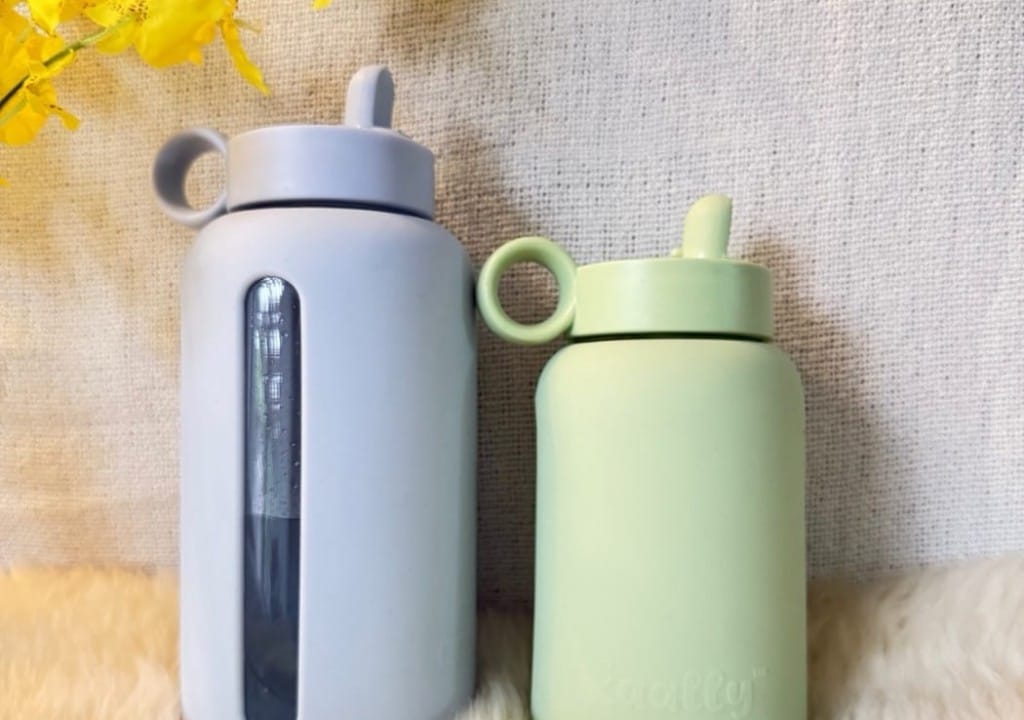
Every bottle we make is pure borosilicate glass, paired with LFGB-certified silicone and a protective sleeve — from our KaaKaaBaby straw bottles for babies and toddlers to our larger Kaally bottles for big kids and grown-ups. The result is the safety of glass — no leaching, no plastic taste, easy to sterilise — without the fragility you’re picturing. They’re consistently 5-star reviewed by Aussie families, and backed by our Drop Guarantee — 30 days on Kaally bottles, 90 days on the KaaKaaBaby bottle: if the glass breaks inside the sleeve within that window of proper use, we replace it.
If you’ve been hovering over the “add to cart” button wondering whether glass is sensible for a busy family, this is exactly the combination it was built for. For babies and toddlers, the KaaKaaBaby Glass Bottle with Silicone Straw & Sleeve is made for little hands (and big throws). For older kids and grown-ups, the Kaally Glass Bottle 500mL suits everyday and school bags, or the 800mL if you’d rather refill less often. (And once it’s yours, here’s how to keep the silicone straw spotless.)
Frequently asked questions
Is borosilicate glass toxic?
No. Borosilicate glass is non-toxic, lead-free and BPA-free, and it doesn’t leach chemicals into food or drink at any temperature.
Is borosilicate glass safe for hot drinks?
Yes. Its heat resistance is the reason it’s used for teapots, coffee carafes and cookware. It handles hot liquids without cracking or releasing anything into the drink.
Is borosilicate glass microwave and dishwasher safe?
The glass itself is both. Where a bottle has a silicone sleeve or lid, check the care guide for that product — but the borosilicate glass component is microwave- and dishwasher-safe.
Is borosilicate glass safe for babies and toddlers?
Yes — it’s a common choice for baby bottles precisely because it’s inert and easy to sterilise. The practical concern with little ones is breakage, which a silicone sleeve is designed to handle.
Does borosilicate glass break easily?
It’s stronger than ordinary glass, but it’s still glass and can break on a hard enough impact. A silicone sleeve absorbs most everyday drops, which is why we build ours that way.
Thank you for this informative post! As a parent, I appreciate the detailed insights on borosilicate glass. It’s reassuring to know that it’s both durable and safe for everyday use. I’ll definitely be considering it for our kitchenware.